
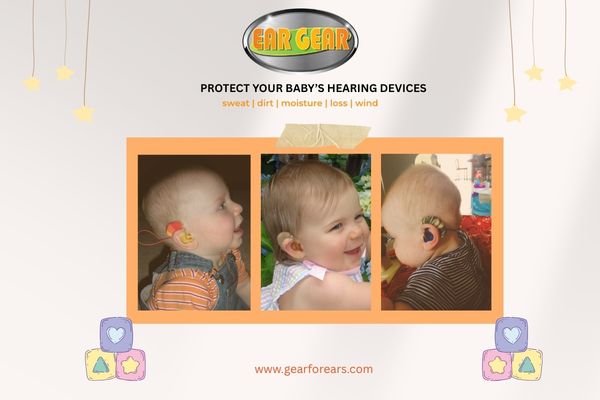
Ear Gear and Babies
A Clinical Brief for Pediatric Audiologists
As an audiologist, you occupy a uniquely influential position in a child’s hearing journey: the day a family leaves your clinic with their first pair of pediatric hearing aids. The weeks that follow determine whether that infant receives the consistent auditory access their developing brain requires. Recommending Ear Gear at the fitting appointment is one of the simplest, highest-impact interventions available to clinicians today.
The Evidence Base
Current data indicate that infants wear their hearing aids only 20% of the time, and children overall approximately 40%. As noted by Success for Kids with Hearing Loss, a child wearing hearing aids only 2½ of 12 waking hours is, by kindergarten, the equivalent of four fewer years of early listening and language exposure.
A landmark study, Consistency of Hearing Aid Use in Infants, identified the contexts in which caregivers most often discontinue use — outdoor play, car rides, and family outings — and traced them to three recurring concerns:
• Fear of damage or loss
• Retention failures related to active movement
• Environmental factors — wind, moisture, and perspiration
These are precisely the variables Ear Gear was engineered to address.
Retention as Clinical Intervention
A Hearing Review survey of retention products observed that infant pinnae are soft and pliable, hearing aids dislodge readily, and once caregivers witness repeated dislodgement, device use is frequently discontinued.
Each minute the device is off the ear represents lost auditory input during the period of greatest neuroplasticity. Retention should therefore be regarded not as a cosmetic accessory, but as the practical difference between prescribed amplification and delivered amplification.
Financial Considerations for Families
Pediatric hearing aids range from $1,000 to $4,000 per device (CareCredit), and many family insurance plans impose caps on, or exclude entirely, replacement coverage. A device lost in a stroller, sandbox, or car seat can represent a four-figure financial event for a family.
The Ear Gear retention cord secures the device to clothing — a modest upfront investment that safeguards the hearing aid and removes one of the leading reasons caregivers disengage from consistent daily use.
Clinical Benefits of Ear Gear for Infant Patients
• Loss prevention through the integrated retention cord and clothing clip
• Moisture and perspiration protection — essential for drooling, feeding, and stroller use
• Wind noise reduction — mitigating a common trigger for device removal
• Barrier against dirt and debris during tummy time, floor play, and outdoor activity
• Soft spandex sleeve that does not interfere with pinna fit, retention, or acoustic feedback
Each benefit corresponds directly to a caregiver-reported barrier documented in the peer-reviewed literature.
The Weight of Your Recommendation
Caregivers consistently rank the audiologist as their most trusted source of guidance — above online resources, peer forums, and manufacturer materials. By introducing Ear Gear at the fitting appointment alongside earmolds and batteries, clinicians help establish device protection as standard of care rather than an optional add-on.
Equally important, the recommendation gives families the confidence to use the devices in real-world environments — outdoors, in vehicles, and in the homes of extended family — the very settings in which incidental language exposure occurs.
Protect your hearing device from dirt, sweat, moisture, loss and wind.